HerbBlueMap
Shennong Bencao Jing
024 / 030
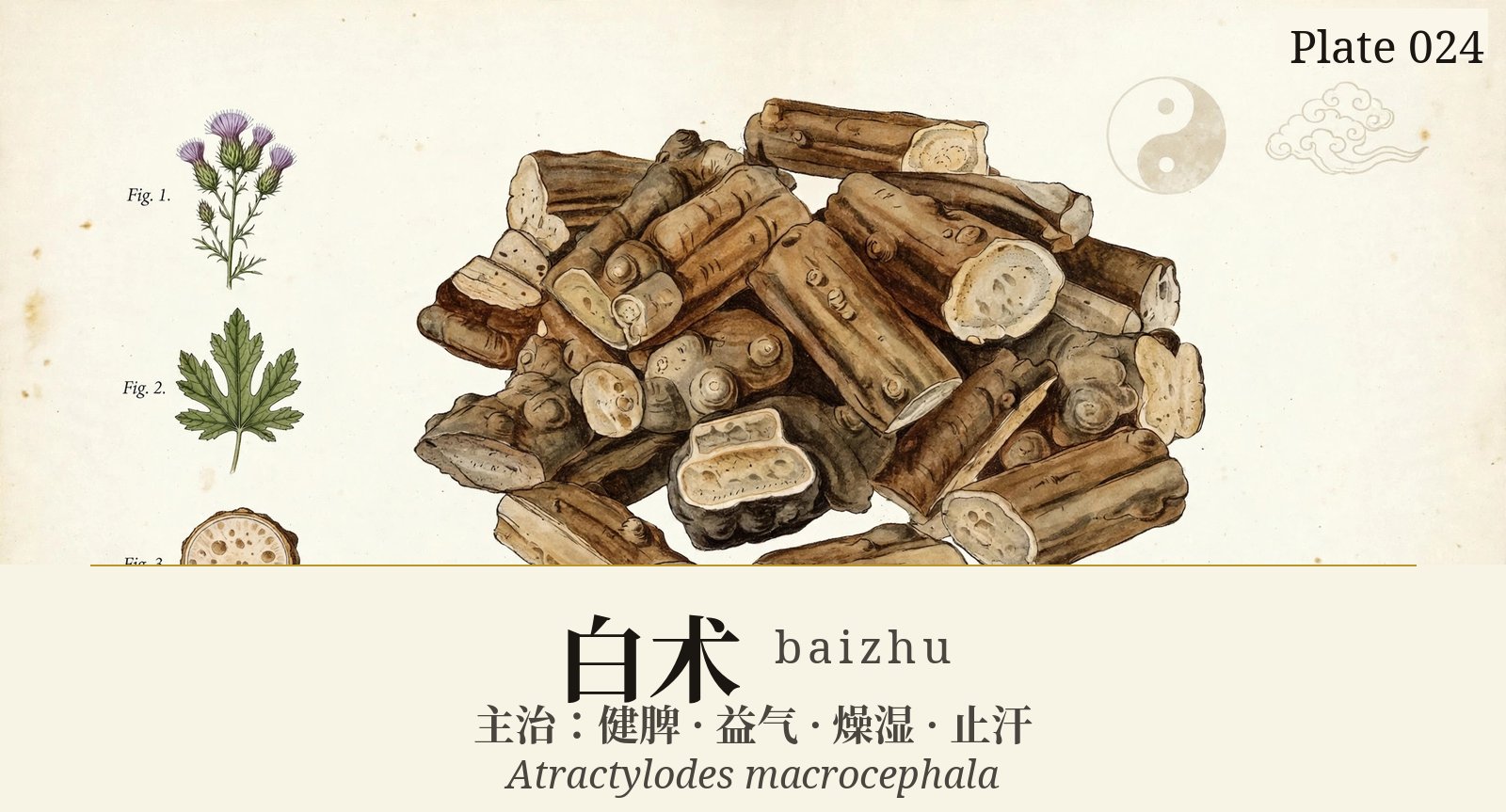
Baizhu (Atractylodes Root) — classical plate
Atractylodis Macrocephalae Rhizoma · Atractylodes Root Plate 024
Atractylodis Macrocephalae Rhizoma
白术 Baizhu
Atractylodes Root
Rhizoma Atractylodis Macrocephalae
Nature & FlavorBitter, sweet; warm
ChannelsSpleen, Stomach
Actions
Fortifies the spleenBoosts qiDries dampnessChecks sweating
Six ChannelsTaiyin spleen deficiency, dampness lodged within
The ClassicThe original text

「味苦温。主风寒湿痹,死肌,痉,疸,止汗,除热,消食,作煎饵。久服轻身延年,不饥。」

Bitter in flavor, warm. It treats wind-cold-damp blockage, deadened flesh, spasms and jaundice; it stops sweating, clears heat and helps dissolve food, and is made into a decoction to drink. Taken over a long time, it lightens the body, extends the years and wards off hunger.

RootBro's note — Baizhu is the core herb of Taiyin disease — a deficient spleen bogged down by dampness. In Ling Gui Zhu Gan Tang, baizhu dries dampness and fortifies the spleen while fuling (poria) leaches dampness out: a two-pronged 'dry it + drain it' strategy that pulls the foundation out from under the dampness itself.
PhD InsightA systems-biology reading
Key constituents atractylone and atractylenolides promote gastrointestinal motility and increase digestive-fluid secretion, with anti-inflammatory and immunomodulatory effects as well.
Atractylenolide I · 白术内酯I
Activates motilin receptors → gastric emptying ↑ → a stronger spleen and better digestion. Inhibits IL-1β and TNF-α → intestinal inflammation ↓. Promotes lymphocyte proliferation → immune function ↑. Three actions that map directly onto 'fortify the spleen, boost the qi.'
Baizhu vs. cangzhu (the other atractylodes): same plant family, different emphasis — baizhu leans toward tonifying the spleen and boosting qi, cangzhu toward drying dampness and moving the spleen. Baizhu carries more atractylenolides (the tonifying side); cangzhu carries more atractylodin (the drying side). Classical formulas mostly use baizhu, the warm-disease school mostly cangzhu — the choice turns on deficiency vs. excess.
Logic PairingClassical pairings
Ling Gui Zhu Gan Tang (Poria, Cinnamon Twig, Atractylodes & Licorice Decoction)Wu Ling San (Five-Ingredient Powder with Poria)Zhen Wu Tang (True Warrior Decoction)Fuzi Tang (Aconite Decoction)Li Zhong Tang (Regulate-the-Middle Decoction)
← Previous Huangqi · 黄芪

⚠️ Safety note: This page is study material on the Chinese medical classics, offered for cultural and educational understanding only. It is not a diagnosis, a prescription, or a promise of treatment. Herbs are medicine — use them only under the guidance of a licensed practitioner, and never compound or take them on your own.

HerbBlueMap HomePain Point FinderHerb Library中文原版 · Chinese Edition (tcmus.net)