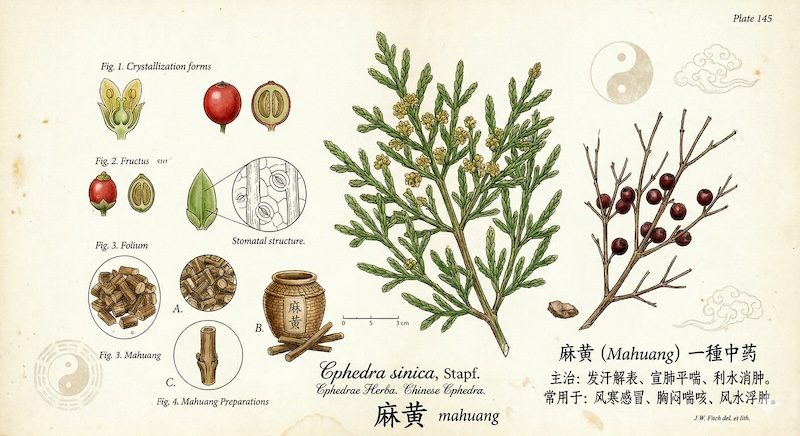
The Classic
The original text
「味苦温。主中风伤寒头痛,温疟,发表出汗,去邪热气,止咳逆上气,除寒热,破癥坚积聚。」
Bitter in flavor, warm. It treats wind stroke and cold damage with headache, warm malaria, releases the exterior and brings out sweat, expels heat pathogens, stops cough and upward-rushing qi, removes cold and heat, and breaks up hard masses and accumulations.
RootBro's note — The strongest sweat-inducing herb in the classical formulary. 'Breaks up hard masses and accumulations' shows the ancients already observed its powerful metabolic activation; modern research confirms ephedrine is a potent sympathomimetic.
PhD Insight
A systems-biology reading
Its key constituent ephedrine is a natural beta-adrenergic receptor agonist: it directly activates the sympathetic nervous system, causing bronchodilation, faster heart rate, higher temperature and forced sweating.
Ephedrine · 麻黄碱
β1/β2 receptor agonism → bronchial smooth muscle relaxes (calming wheeze) + sweat glands activate (inducing sweat) + renal vessels constrict (promoting urination). Three effects answering the three classic actions, with a clear mechanism for each.
'No sweat — use mahuang; sweat present — use guizhi': the difference is that ephedrine forces the sweat glands open, fitting cold that has sealed the exterior shut, while cinnamaldehyde gently dilates the periphery, fitting disharmony of nutritive and defensive qi. One picks the lock by force; the other adjusts the gate.
 HerbBlueMap