The Classic
The original text
「味甘温。主咳逆上气雷鸣,喉痹,下气,产乳,金创,寒心奔豚。」
Sweet in flavor, warm. It treats cough and upward-rushing qi with thunderous rumbling, throat blockage, sends qi down, childbirth and nursing, wounds from metal, and cold-hearted running-piglet qi.
RootBro's note — 'Sending qi down' is xingren's core action — not simple cough suppression, but lowering the lung qi's tendency to rebel upward. Mahuang diffuses the lung, xingren sends qi down; in Mahuang Tang the two form a complete breathing-regulation mechanism of ascent and descent in coordination.
PhD Insight
A systems-biology reading
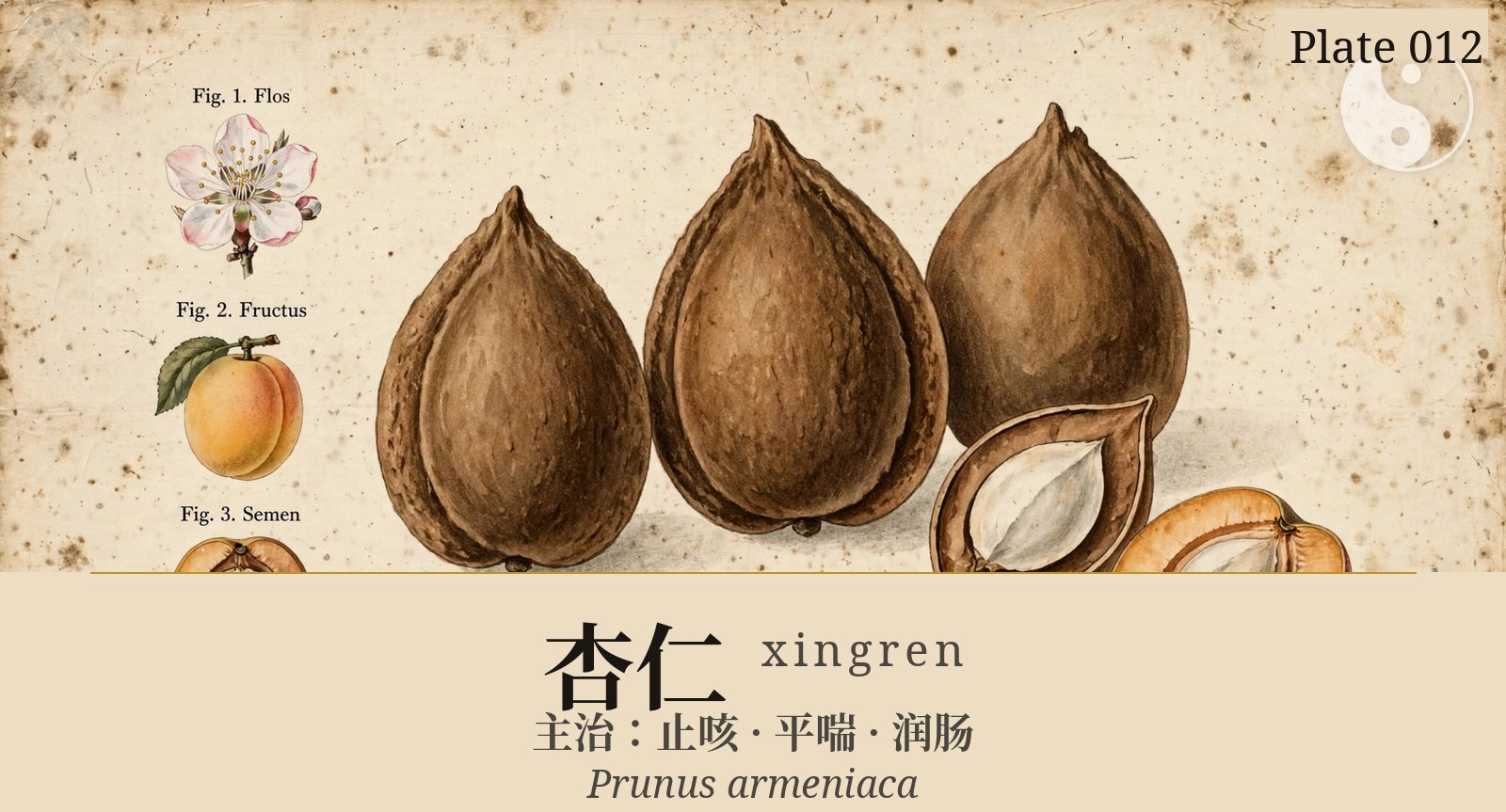
Its key constituent amygdalin hydrolyzes in the body to release trace amounts of hydrocyanic acid (HCN), which suppresses the excitability of the medullary respiratory center — the cough-calming, wheeze-settling effect, and the material basis of 'slightly toxic.'
Amygdalin → HCN · 苦杏仁苷 → 氢氰酸
Hydrolyzed by β-glucosidase → trace HCN released → respiratory center suppressed → cough and wheeze calmed. Apricot kernel oil also lubricates the intestines → moistening laxation. Precise dosage is the key; excess HCN is poisonous.
'Moistens the intestines' and 'stops cough, calms wheeze' look contradictory but share one root: apricot kernel oil lubricates the digestive tract while HCN acts on the respiratory center — two constituents, two targets. Lung and large intestine are interior-exterior paired; the classical formulary noticed this anatomical-functional link long ago.
 HerbBlueMap