HerbBlueMap
Shennong Bencao Jing
004 / 030
Pinelliae Rhizoma · Pinellia Plate 004
Banxia (Pinellia) — classical plate
Pinelliae Rhizoma
半夏 Banxia
Pinellia
Rhizoma Pinelliae Preparatum
Nature & FlavorPungent; warm; toxic
ChannelsSpleen, Stomach, Lung
Actions
Stops vomitingTransforms phlegmDissipates lumps
Six ChannelsUsed often in Shaoyang and Taiyin patterns
The Classic The original text

「味辛平。主伤寒寒热,心下坚,下气,喉咽肿痛,头眩胸张,咳逆,肠鸣,止汗。」

Pungent in flavor, neutral. It treats cold damage with alternating cold and heat, hardness below the heart, qi rushing downward, swollen painful throat, dizziness and distended chest, cough with counterflow, rumbling intestines, and it stops sweating.

RootBro's note — 'Hardness below the heart' means a stuffed, blocked feeling in the pit of the stomach — banxia specializes in the rebellious-qi symptoms that come from disordered gut motility. It is the anti-vomiting core of both Xiao Chaihu Tang and Banxia Xiexin Tang.
PhD Insight A systems-biology reading
Its core mechanism is suppressing the medullary vomiting center while promoting gastrointestinal motility. Its alkaloids antagonize the 5-HT₃ receptor — a mechanism close to the modern antiemetic ondansetron.
Homogentisic acid · 尿黑酸 + 生物碱
5-HT₃ receptor antagonism → vagal afferent signaling suppressed → vomiting stops. It also promotes motilin secretion → faster gastric emptying → fullness and lumps disperse.
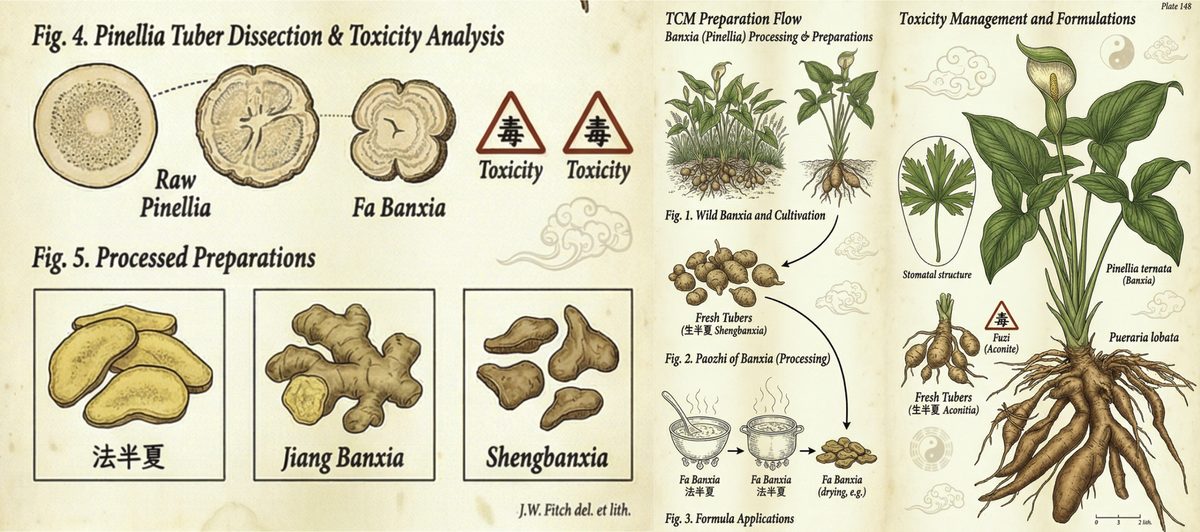
Banxia must be processed before use: raw banxia contains calcium oxalate needle crystals that fiercely irritate the mucous membranes. Jiang banxia (ginger-processed) is the standard classical form — ginger is also banxia's natural antagonist, and pairing the two is a classic piece of safety engineering.
Logic Pairing Classical pairings
Xiao Chaihu Tang (Minor Bupleurum Decoction)Banxia Xiexin Tang (Pinellia Decoction to Drain the Epigastrium)Xiao Banxia Tang (Minor Pinellia Decoction)Banxia Houpo Tang (Pinellia & Magnolia Bark Decoction)Wen Dan Tang (Warm the Gallbladder Decoction)Er Chen Tang (Two-Cured Decoction)
← Previous Fuzi · 附子

⚠️ Safety note: This page is study material on the Chinese medical classics, offered for cultural and educational understanding only. It is not a diagnosis, a prescription, or a promise of treatment. Herbs are medicine — use them only under the guidance of a licensed practitioner, and never compound or take them on your own.

HerbBlueMap HomePain Point FinderHerb Library中文原版 · Chinese Edition (tcmus.net)