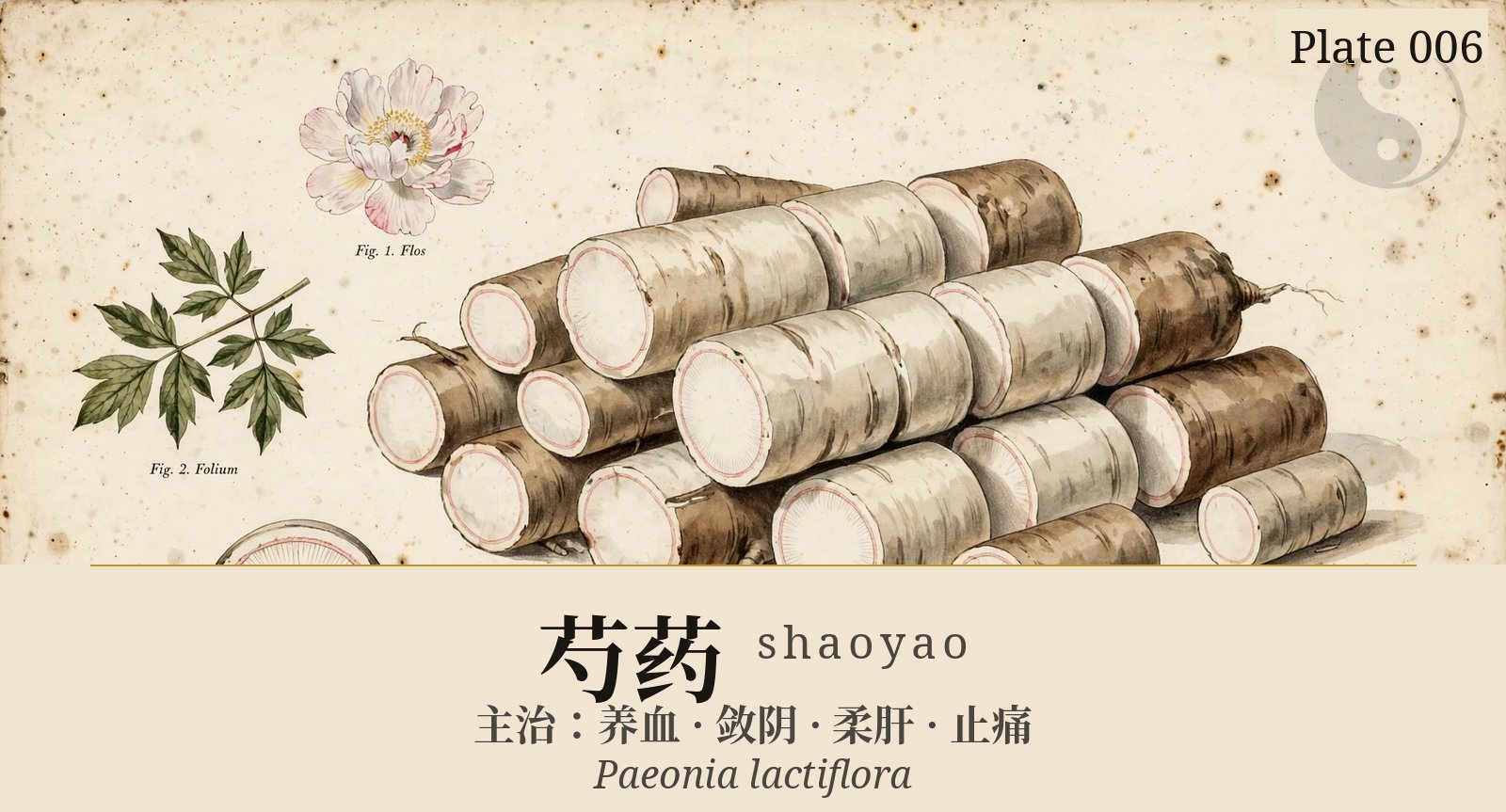
The Classic
The original text
「味苦平。主邪气腹痛,除血痹,破坚积,寒热疝瘕,止痛,利小便,益气。」
Bitter in flavor, neutral. It treats pathogenic qi with abdominal pain, removes blood blockage, breaks up hard accumulations, cold-and-heat mounting lumps, stops pain, promotes urination, and boosts the qi.
RootBro's note — 'Abdominal pain' and 'relieving pain' are its core. In Guizhi Tang, shaoyao is in charge of 'gathering in': guizhi disperses, shaoyao astringes — one opens, one closes, together forming the complete mechanism that harmonizes nutritive and defensive qi.
PhD Insight
A systems-biology reading
Its key constituent paeoniflorin is a natural smooth-muscle antispasmodic: by inhibiting intracellular Ca²⁺ release it relaxes smooth muscle in the gut, uterus and blood vessels, producing analgesic and spasm-relieving effects.
Paeoniflorin · 芍药苷
Ca²⁺ antagonism → smooth muscle relaxes (spasm and pain relief) + immune regulation (Th1/Th2 balance) + central analgesia (adenosine A1 receptors). Three analgesic mechanisms in synergy.
White peony vs. red peony — same plant, different processing: white peony (stir-fried) leans toward nourishing blood and softening the liver, for deficiency patterns; red peony (raw) toward moving blood and dispelling stasis, for excess patterns. Classical formulas mostly use white peony, taking its yin-astringing, pain-stopping action.
 HerbBlueMap